

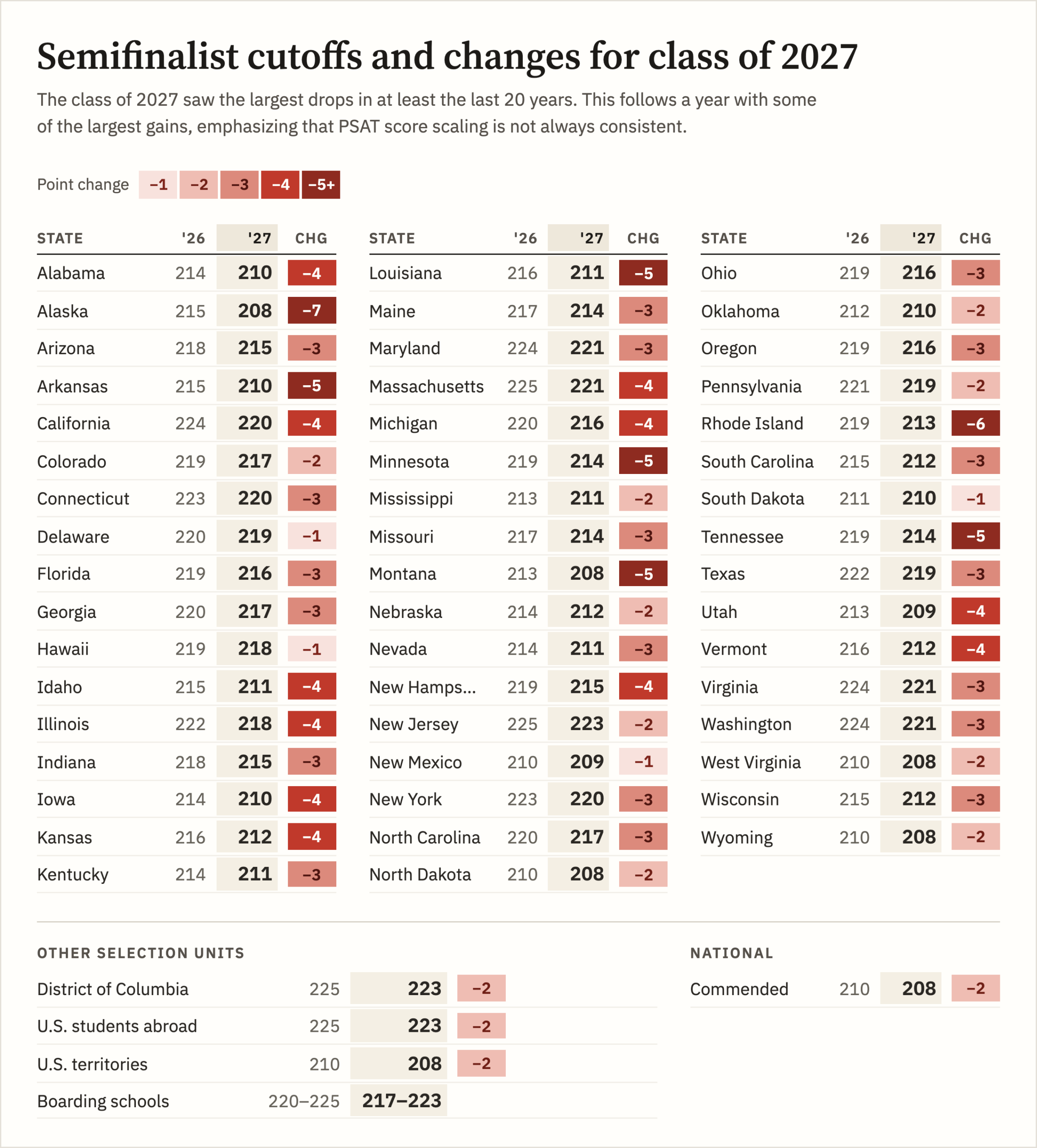
After months of speculation and projections, the official National Merit Semifinalist cutoffs for the class of 2027 were released September 9th. On average, these are the lowest cutoffs in National Merit history, with all 50 state cutoffs sitting lower than they did last year. Most cutoffs went down at least 3 points from the class of 2026’s figures. Alaska set the pace with a 7-point decline. New Jersey again finished with the highest mark, dropping from 225 to 223. Compass will explore:
- How the class of 2027 results stack up historically and how cutoffs are set
- The lower number of Semifinalists nationally
- Why cutoffs declined so precipitously. Hint: It’s not the students.
- The implications of score instability for students, schools, and states
- What the class of 2028 might expect after they take the PSAT/NMSQT in October 2026 and on what timeline
The junior-year PSAT is also the National Merit Scholarship Qualifying Test (NMSQT). Each year, National Merit recognizes the top 55,000 test takers. To be included in that group, students must be among the top 4% of the 1.3 million eligible students who take the PSAT. Of that elite group, approximately 16,500 are recognized as Semifinalists for having the highest scores within their states. Semifinalists have the opportunity to continue in the program to become Finalists and, potentially, scholarship recipients. Some colleges provide significant scholarships and even “full-rides” for Finalists. The remaining 39,000 students are recognized as Commended Students. More information can be found in our National Merit Explained post.
National Merit uses the Selection Index (SI), found on the PSAT score report, to rank students. The Selection Index is calculated by doubling the Reading & Writing score (RW), adding the Math score (M), and dividing that sum by 10. For example, a student with a 720 RW and 700 M score has a Selection Index of 214: (720 x 2 + 700) ÷ 10. A student with a 700 RW and 720 M has a Selection Index of 212. The highest SI a student can receive is 228 (760 RW and 760 M). The weighting of the index means that not all students with the same Total Score have the same SI. “Will a 1450 qualify?” is not the right question. Instead, look at whether a 750 RW and 700 M will qualify.
Summarizing the changes seen for the class of 2027
In October 2015 the PSAT moved to a 320-1520 scale, which was set to provide vertical alignment with the SAT’s 400-1600 scale. The class of 2017 was the first group of students taking the redesigned PSAT/NMSQT, so the fairest comparisons are in the last eleven class years.
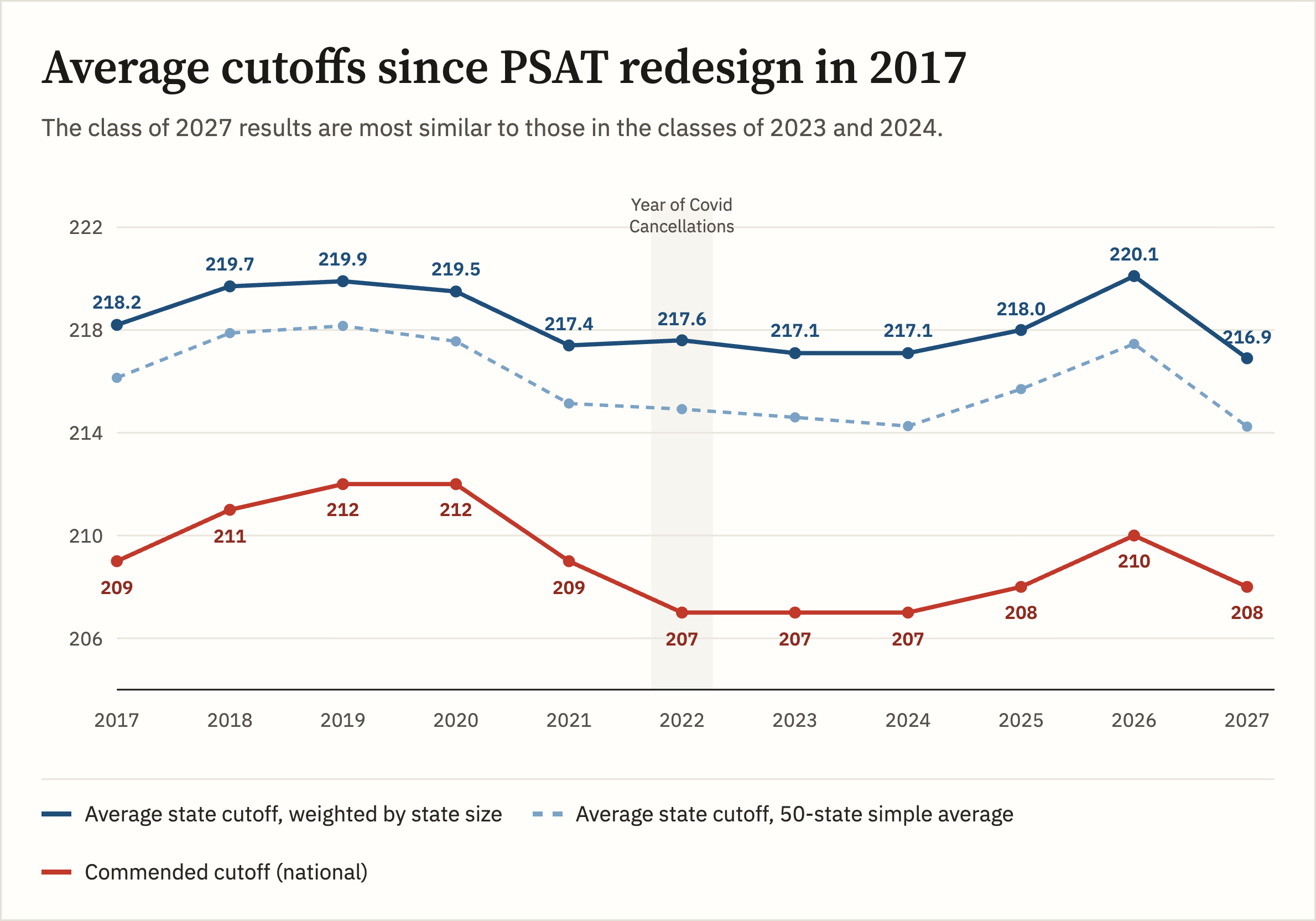
This year saw the average Semifinalist cutoff hit a record low. It provided something of a mirror image to the class of 2026. Last year, 11 states set new record highs in the modern PSAT era, and 10 more tied their records. This year, 5 states established new lows, and 18 tied their record lows. Kansas and Minnesota both dropped 2 points below their previous lows, an unusual event for mid-sized states. Even more unusual was what happened in the largest dozen states. None of those has ever seen a drop of more than 3 points, but this year saw California, Illinois, and Michigan fall 4 points.
Results this year were closer to those in the class of 2024 than they were to the previous two years’ results. Recency is not always a predictor of future results. The Commended level, which is set nationally, declined 2 points this year to 208. The Semifinalist cutoffs, in contrast, fell 3 points.
Entry requirements for National Merit versus qualifying for National Merit.
Your PSAT/NMSQT score report tells you whether you meet the eligibility requirements for the NMSP. In general, juniors taking the October PSAT are eligible. If you have an asterisk next to your Selection Index, it means that your answers to the entrance questions have made you ineligible. Your answers are conveniently noted on your score report. If you think there is an error, you will also find instructions on how to contact NMSC. Meeting the eligibility requirements simply means that your score will be considered. Approximately 1.3 million students enter the competition each year. Only about 55,000 students will be named as Commended Students, Semifinalists, Finalists, or Scholars. See National Merit Explained for more information.
Why did the total number of Semifinalists decline?
After recognizing more than 17,000 Semifinalists in the prior two years, the class of 2027 saw only 16,230, a decline of 5%. The decline in Semifinalists is a separate issue from lower cutoffs. Setting cutoffs can be a blunt tool. In a large state, there may be more than 200-300 students at a single score. Small states might have multiple scores with zero students. NMSC can’t always hit its targets on the nose. Below are the largest swings in both directions.
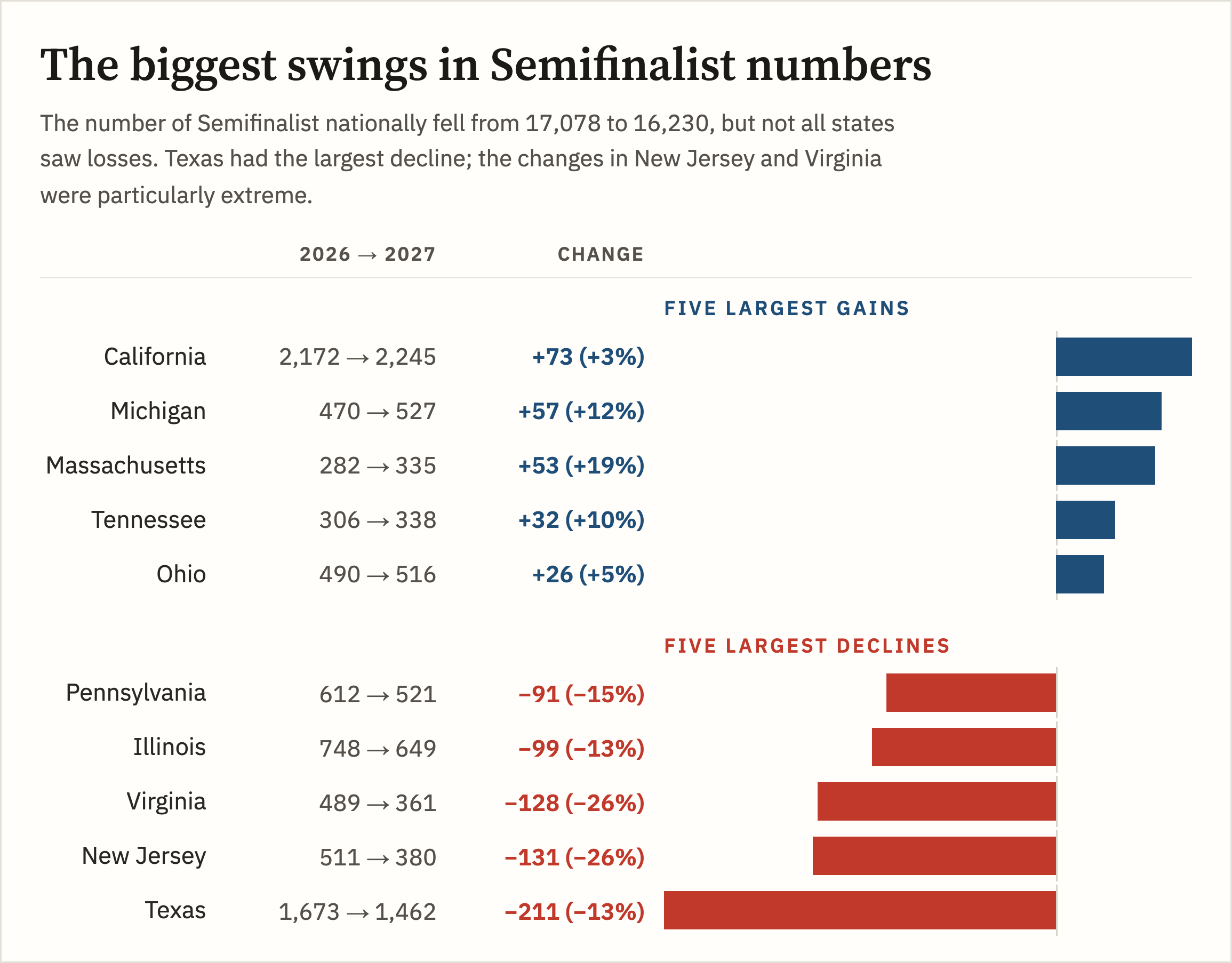
How Semifinalists are allocated among states
It’s possible that NMSC recalibrated the total target number of Semifinalists this year. It helps to understand how National Merit sets cutoffs. NMSC allocates a target number of Semifinalists to states based on their population of high school students, not all of whom take the PSAT. If Texas is allocated 1,500 Semifinalists based on its population of high school graduates, then NMSC works down from a perfect 228 Selection Index until it gets as close as possible to that target. In the class of 2027, 1,462 students scored at or above the cutoff of 219. A cutoff of 220 would have produced too few Semifinalists. A cutoff of 218 would have gone over the allocation. As scores go lower, more and more students occupy each level, and where the crowd forms does not stay consistent from year to year. It is easy for cutoffs to move up or down a point even when there is minimal change in testing behavior or performance. All students at or above a cutoff qualify.
The changes in the above chart fit within the historical pattern, so students should expect similar swings to happen in the future. New Jersey had about the same number of Semifinalists in 2023 as it saw this year, and actually fell from a greater height compared to 2022. Similarly, Texas saw fewer than 1,462 Semifinalists in classes of 2020, 2021, and 2022. And there is little chance that NMSC calculated that Texas’ high school population was falling faster than, say, California’s. We won’t know until next September whether the 16,230 Semifinalists was a fluke or a new standard.
The Mystery of the Declining PSAT Scores
When you have eliminated the impossible, whatever remains, however improbable, must be the truth. National Merit cutoffs may not have the makings of a Sherlock Holmes novel. The guilty party is too easy to identify and the deduction not all that improbable. To borrow from another mystery trope: it’s College Board in the testing room with a faulty scale.
When test scores change from year-to-year, College Board issues press releases discussing testing patterns and student achievement. What they never include is “That one’s on us.” When it comes to National Merit scores, however, it often is.
A history of change
Over the last seventeen years, there have been six classes that saw cutoffs change in more than forty states. The heat strip below shows how cutoffs shift from year to year.
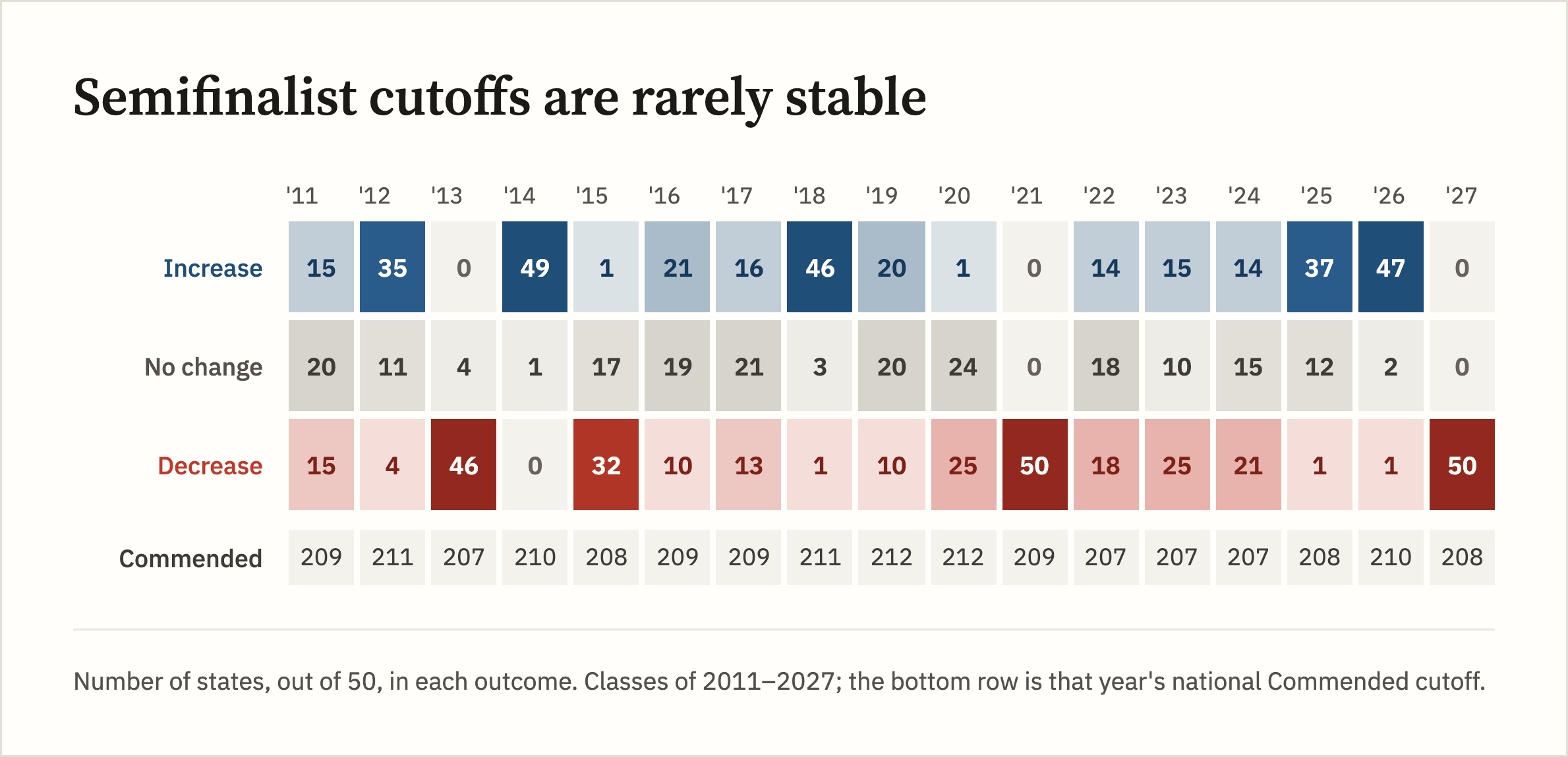
Even if we eliminate “bounce back” years where scores come back into line after an unusual shift, a major disruption occurs approximately every 4 years. Interestingly, none of those scoring disruptions can be attached to the biggest behavioral disruption of all — the Covid cancellations that drove PSAT/NMSQT volumes below one million for the first time in decades. In addition to last year’s exam, the PSATs from 2011 (class of 2013), 2016 (class of 2018), and 2019 (class of 2021) stand out as problematic. The anomalous 2019 results could be traced back to a particularly mis-scaled form, which I wrote about at the time. The class of 2014 also saw significant changes, but those were more of a bounce-back from the previous year, similar to what we are seeing with the class of 2027.
When Semifinalist cutoffs reached vertiginous levels last year, several theories made the rounds:
- (A) Covid-related learning losses were vanquished
- (B) The integrated Desmos calculator on the digital PSAT had “broken” the Math section
- (C) Test preparation — and maybe AI-enabled test preparation — had made the test too easy
- (D) The test taking population shifted
Compass disputed each of these theories, but it wasn’t until this year’s free-fall that we could put each of them fully to rest. A key piece of evidence is which scores rose and fell.
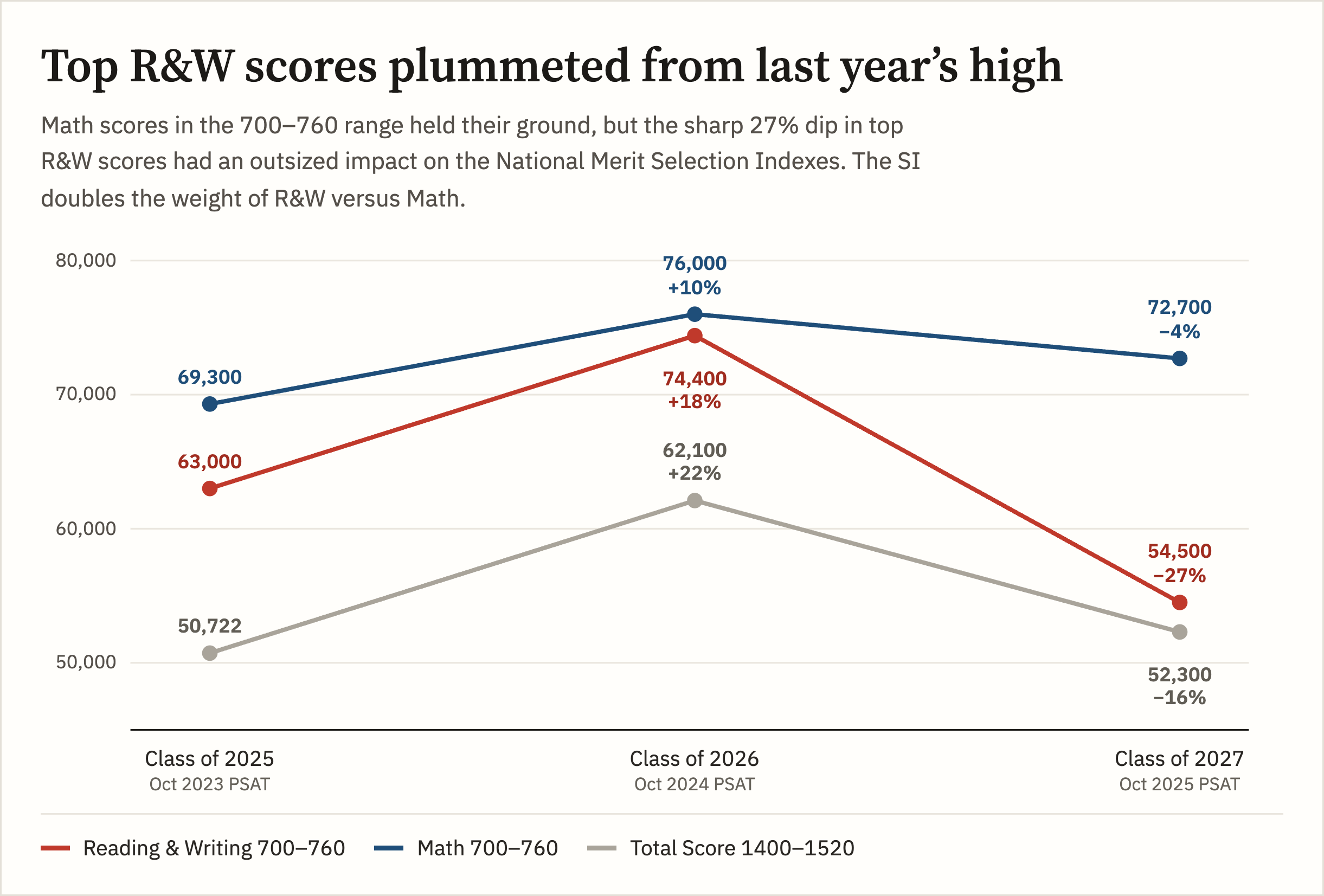
Over the most recent three PSATs, the highest reported Math scores (College Board groups all 700-760 scores together) did go up on the October 2024 PSAT, but they settled back down on the October 2025 PSAT. If improving Math skills were the key driver, why did they not keep progressing upward? The fall PSAT also provides an inherent double-check, because sophomores and juniors both take the exam in similar numbers. Sophomores and juniors consistently tracked each other across the different exams. The class of 2025 and 2026 overlapped, then 2026 and 2027, and then 2027 and 2028. Every PSAT the movement has been similar. Yet sophomores do not do test preparation in sufficient force to shape score results. The sets of classes were in different points of math development during remote learning, and yet they showed the same rises and falls. Learning loss and test preparation do not provide coherent answers.
Reading & Writing scores were the true driver of the class of 2026 records and the 2027 declines
High RW scores are typically less common than high Math scores. But on the October 2024 PSAT, almost as many students scored 700-760 on RW as on Math. Top scores went up by 18%. The double-weight that RW scores provide in the Selection Index pushed cutoffs to new highs. The 210 Commended ranked only fourth when compared to the previous decade. Earlier class years saw cutoffs of 211 and 212 (twice). So why did last year’s cutoffs rise to levels that had seemed impossible? The highest cutoffs had never exceeded 223 (Maryland’s 224 in the class of 2022 was due to every PSAT in the state being cancelled and students qualifying via SAT scores). How did New Jersey and Massachusetts reach 225 and California, Maryland, Virginia, and Washington end up at 224? The best explanation is that the very top RW scores — 740-760 — increased at an even higher rate than 700-730s. A 225 cutoff is not possible without at least a 750 RW. A 224 requires at least a 740 RW. Students were acing the test in record numbers.
The plummet for the class of 2027
On the 2025 PSAT, the number of high RW scores dropped by 27%. In fact, the RW count for the class of 2027 is even lower than it was two years ago. The surfeit of 700+ scores dried up. Obtaining a 740-760 grew harder. As with Math scores, sophomore performance changes matched that of juniors.
Process of elimination
The rapid gains and collapse eliminate (A), (B), and (C). As sophomores, the class of 2027 was phenomenal at reading according to the PSAT. Post-Covid learning changes cannot explain why they suddenly struggled as juniors. Option (B) doesn’t fit, because Math scores were not the source of the changes. Why would test preparation have stopped working (C), and how can it explain that sophomores and juniors were similarly impacted across the years? This leaves (D) as a remote contender. Except that it fails to explain the 50-state reach of the changes and the magnitude of the changes even in the largest states.
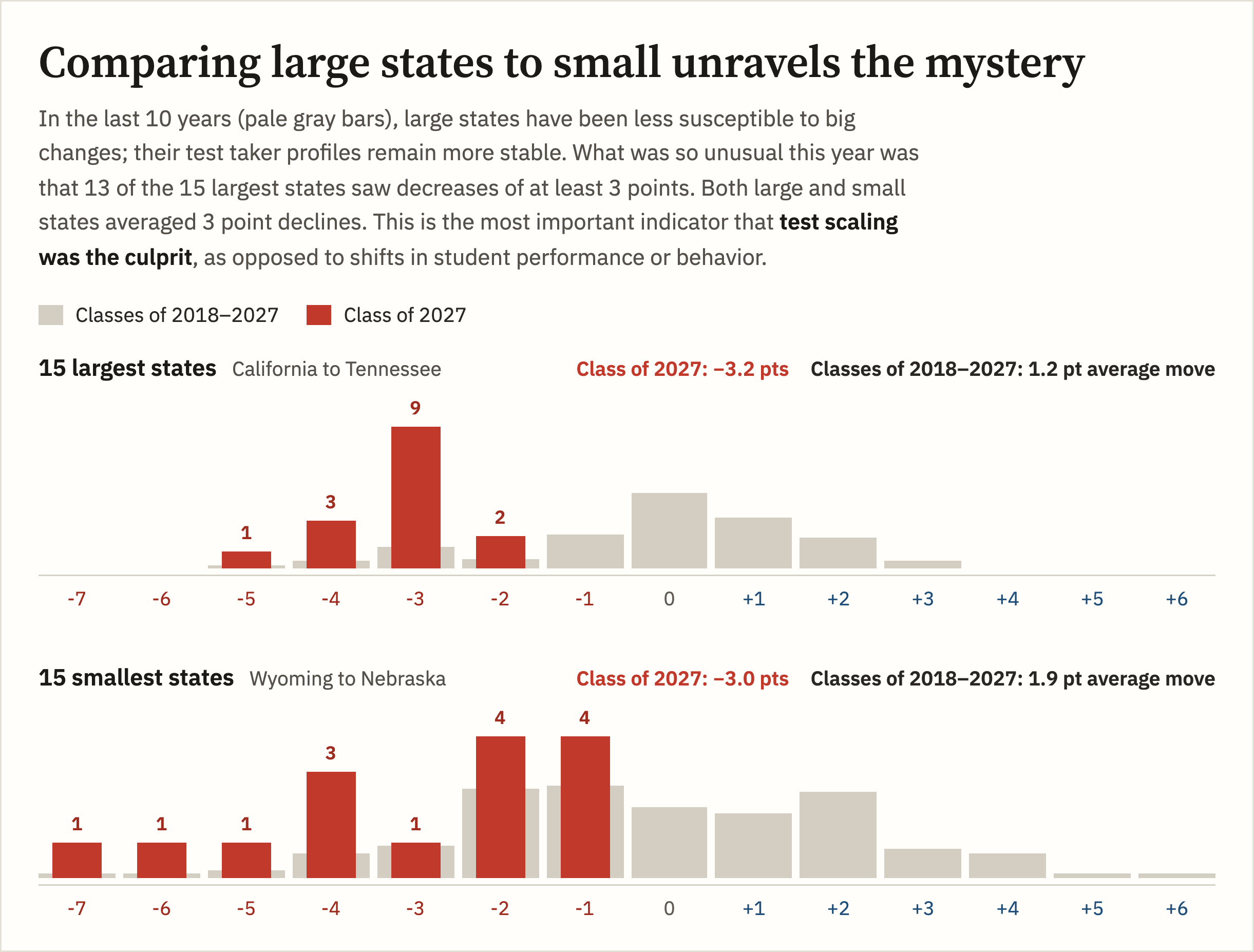
Thirteen of the largest fifteen states dropped by 3 points or more. Pennsylvania and New Jersey saw 2-point declines. If the smaller states were pulling down the class of 2027’s average cutoffs, we might at least attribute some of the disruption to the instability of cutoffs when there are fewer than 100 Semifinalists. That’s not what happened. And if only a few large states saw inflows or outflows of top test takers, the impact would have been muted. Nor did overall test taker numbers change much. When the entire set of large states has this magnitude of a change, the test scale itself has to be at the heart of it.
What does a 3-point change represent and why is it so bad?
For simplicity, the change can be characterized as a 15-point miss in RW on the 160-760 scale (200-800 on the SAT).
- The typical annual growth in RW scores is about 40-50 points, so the scale change represents approximately one-third of an academic year.
- Systematic scaling error is additive to individual student fluctuations in scores — typically around +/-30 points on each side of the PSAT and SAT. Scaling error makes it harder for students to determine where they will score and how their score stacks up.
- Scaling error produces incorrect percentile ranks, because percentiles are based on the 3 prior years of results. Sudden inflation or deflation gives an inaccurate read.
- The PSAT is used for purposes beyond National Merit such as AP placement or state-mandated testing. Results may not align with prior years or academic growth expectations.
- When error happens primarily on one side of the PSAT, some students are unfairly disadvantaged.
- In a competition such as National Merit where relative standing matters, a uniform increase or decrease might be tolerable. A rising tide lifts all students (sort of). Except that there is no way of knowing whether the error applied equally to all students. The digital PSAT is not a single form or even a limited set of forms. Exams across the PSAT testing window can vary, and even on the same test dates, students often see differing questions. It’s one of the security advantages provided by digital testing, but it can also be a curse. College Board provides no reporting on the items or scaling, so students (and Compass) have no way of assessing the impact on individuals. Schools have no way of knowing if their students were hit harder than at other schools.
- This keeps happening. Is College Board having difficulty keeping the digital PSAT scale consistent or will things stay more consistent over time? The historical record says that they will not.
Do these sorts of systematic scaling errors occur on the SAT?
They do. They are harder to spot, but likely even more common. Noted above is that the largest disruptions on the PSAT/NMSQT occur, on average, every 4 years. The SAT is given on (a) 8 national dates every year, (b) during a 2-month SAT School Day window in the spring, and (c) during a 1-month window in the fall. This accelerates the chance for errors. It creates a near certainty that some students will encounter systematic error in their favor and others will see it working against them.
The PSAT and the National Merit Scholarship Program provide a unique laboratory. The PSAT/NMSQT represents one slice in time. The population of PSAT takers is relatively stable from year to year, and the sophomore and junior PSATs provide a sort of longitudinal double-check. The 50 state cutoffs and their varying levels give information about the extent of scaling errors. Comparing ever-shifting SAT dates is difficult, especially because College Board restricts access to the data. It is unfortunate that the primary protection students have is taking the SAT multiple times. In combination with superscoring, it represents the best way for students to lock-in positive error.
How do errors happen? Shouldn’t scores stay consistent?
When new tests are designed, not every problem can be tested on previous populations of students. Instead, a sampling of problems is tested with a sampling of students, perhaps 4-5,000. In theory, that’s a significant enough size that random error will make little difference. The sample group should be comparable to the entire population. Random error is an acceptable part of test creation, because it largely cancels out at scale.
But what if the error is not random? What if the test design is flawed? For example, if the methodology continually overestimates the ability of the sample groups, future questions will be predicted to be harder than they really are. And then over-prediction may happen with the next group. This systematic bias can creep into a test production and equating process. Normally it is spotted. As we see from the October 2024 PSAT and similar examples, sometimes it is not. The National Merit program provides a challenge to test creators, because everything important happens in a narrow part of the scale. On the digital PSAT, only 50 questions count toward a student’s score. Differentiating between a 720 student, for example, and a 730 student, and a 740 student rests on small differences in performance. If College Board has the statistics even slightly off, scores will not align well across tests. We saw the occasional wild ride on the paper PSAT, but the rides may get wilder and more frequent on the digital PSAT.
Predictions and timeline for the class of 2028 and beyond
Compass has always warned students not to be too fixated on a single cutoff target. The crazy events of the last two years have made it obvious that cutoffs can move in large and unexpected ways. It’s better to think in terms of score ranges rather than a pass/fail score. Prior to the PSAT, we can only estimate based on historical figures, without knowing what kind of surprises College Board has in store. After the PSAT, Compass analyzes the national results in the broad buckets that College Board provides. This usually gives a clear idea of which way the overall trend is moving. We should see how RW and Math scores behave, what the 1400-1520 bucket looks like, and develop a tight estimate of the Commended cutoff. For example, here is the estimate from last year.

Unfortunately, it does not provide insight into individual states. In April, the Commended level usually leaks, and we get confirmation of the national trend predictions. It’s not until Semifinalist notifications start being handed out in late August that state-by-state information starts coming into focus.
Below is a pre-PSAT summary. Find the range of potential cutoffs in your state, and how it has stacked up in recent class years. Below the table is more information about the National Merit program. You may also want to consult our post on National Merit Explained, which goes more into the steps of the process, what different honors mean, and what sort of scholarships are available.
State | Class of 2028 (Est Range) | Class of 2027 (Actual) | Class of 2026 (Actual) | Class of 2025 (Actual) | Class of 2024 (Actual) | Avg SF Count |
|---|---|---|---|---|---|---|
| Alabama | 209-216 | 210 | 214 | 212 | 210 | 239 |
| Alaska | 207-217 | 208 | 215 | 214 | 209 | 36 |
| Arizona | 214-220 | 215 | 218 | 217 | 216 | 359 |
| Arkansas | 209-215 | 210 | 215 | 213 | 210 | 145 |
| California | 219-224 | 220 | 224 | 221 | 221 | 2,125 |
| Colorado | 216-221 | 217 | 219 | 218 | 216 | 280 |
| Connecticut | 219-223 | 220 | 223 | 221 | 221 | 182 |
| Delaware | 218-222 | 219 | 220 | 219 | 219 | 43 |
| Florida | 215-219 | 216 | 219 | 217 | 216 | 959 |
| Georgia | 216-220 | 217 | 220 | 218 | 217 | 554 |
| Hawaii | 215-220 | 218 | 219 | 217 | 217 | 62 |
| Idaho | 210-216 | 211 | 215 | 213 | 211 | 90 |
| Illinois | 217-222 | 218 | 222 | 220 | 219 | 693 |
| Indiana | 214-219 | 215 | 218 | 217 | 216 | 320 |
| Iowa | 209-216 | 210 | 214 | 212 | 210 | 152 |
| Kansas | 211-219 | 212 | 216 | 215 | 214 | 147 |
| Kentucky | 210-218 | 211 | 214 | 213 | 211 | 208 |
| Louisiana | 210-217 | 211 | 216 | 214 | 214 | 227 |
| Maine | 211-217 | 214 | 217 | 214 | 213 | 61 |
| Maryland | 220-224 | 221 | 224 | 222 | 221 | 313 |
| Massachusetts | 220-225 | 221 | 225 | 223 | 222 | 322 |
| Michigan | 215-220 | 216 | 220 | 218 | 217 | 509 |
| Minnesota | 213-220 | 214 | 219 | 217 | 216 | 284 |
| Mississippi | 209-215 | 211 | 213 | 212 | 209 | 149 |
| Missouri | 213-217 | 214 | 217 | 215 | 214 | 299 |
| Montana | 207-214 | 208 | 213 | 209 | 209 | 46 |
| Nebraska | 210-216 | 212 | 214 | 211 | 210 | 105 |
| Nevada | 210-218 | 211 | 214 | 214 | 211 | 148 |
| New Hampshire | 213-219 | 215 | 219 | 217 | 215 | 64 |
| New Jersey | 222-225 | 223 | 225 | 223 | 223 | 486 |
| New Mexico | 207-215 | 209 | 210 | 211 | 207 | 99 |
| New York | 219-223 | 220 | 223 | 220 | 220 | 998 |
| North Carolina | 216-220 | 217 | 220 | 218 | 217 | 502 |
| North Dakota | 207-212 | 208 | 210 | 210 | 207 | 28 |
| Ohio | 215-219 | 216 | 219 | 217 | 216 | 588 |
| Oklahoma | 208-216 | 210 | 212 | 211 | 208 | 195 |
| Oregon | 215-221 | 216 | 219 | 216 | 216 | 185 |
| Pennsylvania | 217-221 | 219 | 221 | 219 | 219 | 623 |
| Rhode Island | 212-220 | 213 | 219 | 217 | 215 | 50 |
| South Carolina | 209-217 | 212 | 215 | 214 | 209 | 225 |
| South Dakota | 208-215 | 210 | 211 | 208 | 209 | 39 |
| Tennessee | 213-219 | 214 | 219 | 217 | 217 | 324 |
| Texas | 218-222 | 219 | 222 | 219 | 219 | 1,508 |
| Utah | 208-216 | 209 | 213 | 211 | 209 | 181 |
| Vermont | 211-217 | 212 | 216 | 215 | 212 | 30 |
| Virginia | 219-224 | 221 | 224 | 222 | 219 | 412 |
| Washington | 220-224 | 221 | 224 | 222 | 220 | 353 |
| West Virginia | 207-212 | 208 | 210 | 209 | 207 | 64 |
| Wisconsin | 211-217 | 212 | 215 | 214 | 213 | 295 |
| Wyoming | 207-213 | 208 | 210 | 209 | 207 | 21 |
| District of Columbia | 222-225 | 223 | 225 | 223 | 223 | 36 |
| Studying Abroad | 222-225 | 223 | 225 | 223 | 223 | 87 |
| U.S. Territories | 207-212 | 208 | 210 | 208 | 207 | 39 |
| Commended | 207-212 | 208 | 210 | 208 | 207 |
How cutoffs are determined
Qualifying scores (“cutoffs”) are not based on the total score for the PSAT (320-1520) but on the Selection Index, which is calculated by doubling the RW score, adding the Math score, and then dividing the sum by 10. The maximum Selection Index is 228. Students can find a historical set of cutoff data here or see how Semifinalist and Commended counts have changed state by state. Students still ahead of the October PSAT can prepare with small group PSAT classes built around the Selection Index.
Why does each state have its own Semifinalist cutoff if the program is NATIONAL Merit?
This is always a hot button question. NMSC allocates the approximately 16,500 Semifinalists among states based on the number of high school graduates. That way, students across the nation are represented. It also means that there are very different qualifying standards from state to state. A Massachusetts student with a 220 might miss out on being a Semifinalist. If she lived 10 miles away in New Hampshire, she would qualify.
No Semifinalist cutoff can be lower than the national Commended level. Cutoffs for the District of Columbia and for U.S. students studying abroad are set at the highest state cutoff (typically New Jersey). The cutoff for students in U.S. territories and possessions falls at the Commended level each year. Boarding schools are grouped by region. The cutoff for a given region is the highest state cutoff within the region.
When are National Merit Semifinalists announced?
The lists of Semifinalists will not be distributed to high schools until the end of August 2027. With the exception of homeschoolers, students do not receive direct notification. NMSC asks that schools not share the results publicly until the end of the press embargo in mid-September, but schools are allowed to notify students privately before that date. NMSC does not send Commended Student letters to high schools until mid-September. Compass will keep students updated on developments as the dates approach.
Do state and national percentiles indicate whether a student will be a National Merit Semifinalist?
No! Approximately 1% of test takers qualify as Semifinalists each year, so it is tempting to view a 99th percentile score as indicating a high enough score — especially now that College Board provides students with percentiles by state. There are any number of flaws that rule out using percentiles as a quick way of determining National Merit status.
- Percentiles are based on section scores or total score, not Selection Index
- Percentiles are rounded. There is a large difference, from a National Merit perspective, between the top 0.51% and the top 1.49%
- Percentiles reveal the percentage of students at or below a certain score, but the “at” part is important when NMSC is determining cutoffs.
- The number of Semifinalists is based on the number of high school graduates in a state, not the number of PSAT takers. Percentiles are based on PSAT takers. States have widely varying participation rates.
- Most definitive of all: Percentiles do not reflect the current year’s scores! They are based on the prior 3 years’ performance. They are set even before the test is given. And if you are going to use prior history, why not use the record of prior National Merit cutoffs rather than the highly suspect percentiles?
Entry requirements for National Merit versus qualifying for National Merit.
Your PSAT/NMSQT score report tells you whether you meet the eligibility requirements for the NMSP. In general, juniors taking the October PSAT are eligible. If you have an asterisk next to your Selection Index, it means that your answers to the entrance questions have made you ineligible. Your answers are conveniently noted on your score report. If you think there is an error, you will also find instructions on how to contact NMSC. Meeting the eligibility requirements simply means that your score will be considered. Approximately 1.3 million students enter the competition each year. Only about 55,000 students will be named as Commended Students, Semifinalists, Finalists, or Scholars. See National Merit Explained for more information.

Hi Art,
My student scored high on his PSAT (Looks like he’ll make our state’s NM Semifinalist cut-off) and his ACT.
He had heard about only answering what was required when taking the tests, so we’ve literally not received any mailers or promotional materials.
That’s fine, but I want to make sure we’re not missing anything either.
I’m also a little worried if he filled things out correctly to make sure he’s eligible to be included to be a NM Semifinalist.
He filled out that his graduating year is 2023, but is there anything that he should make sure to check in his College Board account for the PSAT for NM Semi-finalist purposes?
Or anywhere else for anything?
I’m happy not to be getting any marketing materials, but it’s almost a little disconcerting! (Can’t win)
Thank you.
G,
If he logs into his College Board account, there should be a section of the PSAT report for National Merit. It will indicate whether he is listed as eligible.
Your student may have opted out of the Student Search Service that colleges use to buy mailing lists. To be clear, they don’t know anything more than we do about National Merit status. Colleges are allowed to buy names from College Board based on PSAT score ranges. College Board is all too happy to let him change his designation to receive mail.
Hi
Junior (Tx) took PSAT fall 2021 and got 1450); Index 218(99th%)- probably Commened status). Compass shows prediction of 218-222 range with mostly likely Finalist@220 but also shows quite a swing in historical trends. She took SAT Dec 2021 and got 1570(missed 5 Qs). Anymore thoughts on Tx Finalist being closer to 218? While being commended is likely in Tx, does applying to other states with lower finalists scores help in her college applications? If she qualifies for finalist does she have to take another SAT to qualify or can she submit the Dec2021 /1570 number?
Chris,
Yes, Semifinalist cutoffs do move around. We expect to see a down year, so 219 or 220 are possibilities. I have 218 as a borderline case. It hasn’t happened in Texas in 10 years, but this may shape up to be a very unusual year.
I’ve never heard of colleges treating Commended or Semifinalists differently based on where they are located. I don’t think they’d even be allowed to under NMSC rules.
She can submit her Dec SAT as a confirming score. Great job!
Why does it take so long for them to determine/announce recognition and semi-finalists given the test is given in October? You think with technology they should know all their results by December.
Jack,
The gracious interpretation is “if it ain’t broke.” NMSC has barely changed its procedures in 50 years.
It’s not quite as simple as running a database report, because NMSC does need to do checking on their own and then cross-validation with schools to verify student eligibility. They also have different parts of the process running at different times. For example, now is when scholarship matches are taking place for seniors. They also have Alternate Entrants who missed the PSAT and must submit SAT scores. The bottom line is that they feel that the schedule works for them. Even when they are ready to announce the Semifinalists, it’s maddening that they do it with snail mail. Outside of the movies, when was the last time a college used letters rather than the internet to inform students of admission?
Thank you for your insightful article. My daughter has an index of 222, class of 2023, California. Likelihood of her becoming a semi finalist in California?
Sock,
California reached 223 in the class of 2019, but that was a year where scores were high across the board, with a 212 Commended cutoff. We are seeing weakness this year. It seems unlikely that CA will go above 222, but I don’t want to completely discount the possibility. I’d say your daughter’s chances are at least 90%.
Hello,
My daughter is in IL and had a point total of 220 on the PSAT. As it is 1 point above your “most likely,” what would be your ballpark re: her odds? It looks like IL has only gone to 221 when the national PSAT scores were very high, percentage wise.
I also wanted to ask if an SAT exam she took over the summer could be used as the confirming score? She took the SAT the summer before her junior year and scored 1460 (760M, 700R). Of course, she has the SAT coming up again this month and I expect her to do better the second time around, but wanted to see if the first score could be used just in case.
Thanks!
Anon,
Based on what we know right now, I’d say that she is in the 80%+ category. We often find out the exact Commended cutoff in late April. I *expect* it to come in where I’ve predicted, but I’ll feel better once we have it confirmed. If it comes in as low as I think, then I’d bump her chances to 90-95%, IL would have to do something very unusual. If it turns out that the scores were not as low as my research predicted, then it becomes more of a toss-up.
Yes, a student can use scores as early as October of sophomore year. Your daughter’s score works as a confirming score and would already be high enough.
Any chance a 220 in CA can make the cut for the class on 2023?
Drea,
I don’t want to say that it is impossible, but it’s highly unlikely. California’s cutoffs are consistently among the highest in the country. If we see a really low Commended cutoff, it could indicate that scores have fallen nationally more than expected. As I said, it’s not impossible.
Can one low SAT score ruin my daughter’s chances of becoming a National Merit Finalist if she already has a good confirming SAT score? My daughter already has gotten very high confirming score on a previous SAT, so she wasn’t planning on taking the SAT again, but her school is requiring her to take a school-day SAT as a state-wide assessment. She is worried that, if she bombs the school-day test, that would disqualify her from being a National Merit Finalist. When she sends her confirming score to the National Merit Scholarship Program, can she “score choice” and send only the SAT with the best score, or must she send in all her scores? And if she has to send in all her SAT scores, would a low score on one test hurt her chances of becoming a Finalist? Thank you!
Katie,
NMSC uses a student’s highest SAT score. While it does not superscore, there are no circumstances where an outlier score hurts a student. You can use Score Choice or let NMSC choose your daughter’s best score, but the result will be the same.
Thanks so much for the very helpful reply. That really puts my daughter’s mind at ease. And thank you for all you do!
Hi Art, thank you for this very informative article. My daughter (class of 2023) scored a 228 index in Massachusetts, and I’m curious if you know about how many students actually get perfect scores every year. I’m also curious as to whether you know anything about the process of deciding which of the semifinalists become finalists (as I’ve heard most semifinalists make it to finalist standing barring extreme cases, is this true)? As well as which of the finalists get scholarships. Thanks!
Anya,
Congratulations to your daughter! College Board has never published score distributions for the current PSAT. My estimate is that about 1000-1500 students achieve perfect scores each year.
It’s true that most Semifinalists (about 16,000) become Finalists (about 15,000). Semifinalists must get a confirming SAT or ACT score, which basically means an SAT score with a Selection Index of about 210 or higher (trivial for your daughter). They must receive a recommendation from their high school principal. And, the squishiest criteria, they must have “a record of very high academic performance
in all of grades 9 through 12.”
The scholarship process is more complicated. If a scholarship is a Finalist’s only goal, it’s quite simple — choose a college that sponsors National Merit scholarships (technically you must list them as a first choice with NMSC during the matching process)! About half of the 7,500 scholars receive scholarships from their colleges. The other half receive corporate- or NMSC-funded scholarships. With only about 3,500 scholarships for a highly-qualified group of students, these can be quite competitive. NMSC treats Finalist applications in much the way a college would look at applicants, considering essay, application, scores, grades, and recommendation.
Hello Art:
My son (Texas-2023) scored 223 and 1510 in SAT. What is his chance to become National Merit Semi Finalists/Finalists? Will he need a higher SAT score to qualify for Finalists? Thank you.
Shawn,
He will be a Semifinalist with a 223 in Texas. Congratulations! Most Semifinalists become Finalists. The 3 factors (other than completing the application) are a confirming SAT/ACT score, strong grades, and a recommendation from the school. Your son’s 1510 is easily high enough as a confirming score (the level is usually set at the Commended cutoff). NMSC gives no definitive guidelines for what is required for a GPA. I have heard that C’s can pose a problem. Unless there is a disciplinary problem, the school’s recommendation is straightforward.
Hi Art,
My son has a selection index of 216 in Ohio. His best composite on the SAT is a 1420, and he has a superscore of 1480. If he makes the cutoff, will a college that doesn’t accept a superscore think that a semifinalist should have an SAT score higher than a 1420. Do you recommend that he sit for the SAT again? He got a 780 on the math section the first time and hasn’t been able to come close to that in two subsequent tests.
Caroline,
I recommend making SAT retesting decisions regarding college admission separately from decisions about National Merit. We have a fairly good idea of where the SAT Selection Index for the confirming score will fall (around 210). On the other hand, every college has a different way of judging SAT and ACT scores. I would look at how your son’s score stacks up against a school’s admits. I’ve certainly never heard of a college holding NM against a student, so I don’t think you should worry that a school might be expecting a higher score from a Semifinalist.
Hi Art,
As you’ve mentioned, Alternate Entry was a huge factor last year in raising the Selection Index for both Washington DC and Maryland. Some private schools in DC knew about Alternate Entry and advised parents to jump on it, while other schools there somehow missed this information and their very deserving students therefore missed out – even ones with near-perfect SAT scores, because they never submitted them for consideration.
What would stop ALL private schools and “parents in the know” to this year have their students skip the PSAT altogether and instead prepare them to do well on the SAT, since SAT scores provide a much better chance at achieving the required Selection Index score? For example, one private high school in Florida had 51 National Merit Semifinalists last year – second highest school totals in the US. That is a huge number. Were those scores achieved via PSAT or SAT?
You adjusted down a few of your Selection Index score projections after PSAT scores came in. But won’t that change if the majority of pricey private schools and savvy parents instead came up with excuses as to why their kids could only take the SAT for 2023? Many private schools live and die by their National Merit Semifinalist list. It would seem to me that they would definitely at least consider gaming the system this way. It sure worked well for some last year!
Sid,
What would stop them? Primarily ethics with a dose of uncertainty. Alternate Entry has a specific purpose, and I would expect National Merit to clamp down if it felt like AE were being abused. AE was made easier during the pandemic, but the rubber stamp aspect is not something I expect to be permanent.
It’s interesting to speculate how AE might impact cutoffs this year, but one can quickly get tied into knots. I’m fairly certain that no one said last year, “Maryland and only Maryland will hit 224.” I expect to be wrong about many of the estimated cutoffs and try to be honest about it. That’s one of the reasons why I tend to be rigorous about showing my work.
During PSAT registration students are asked to identify a field of study. What we saw last year was a spike in the number of 000 codes (seen next to a student’s name in the list of NMSFs), which indicates no answer to the question or no registration. While not every 000 is an AE student (and not every student with a number is not-AE), there is a strong correlation.
There are schools that like to tout their NMSF numbers, but it might be a stretch to say that they live and die by it.
Hi Art,
As a 221 scorer in California (which also seems to be the ‘most-likely’ score on the chart) I had a couple quick questions I’m hoping you could answer; namely, how confident are you in that most likely number being the actual cutoff for becoming a semifinalist, would all 221 scorers be accepted as semi-finalists if the cutoff in CA is indeed 221, and does becoming a finalist improve your chances to selective colleges or does it not really matter because they are flooded with finalist applications anyways? Any insight would be appreciated!
Anthony,
It is all or nothing. If the cutoff is 221, then everyone at 221 and higher is a Semifinalist.
It depends on who you group as “selective.” If you are zeroing in on Harvard, Yale, Stanford, etc., then, yes, they are flooded by Finalist applications. Schools that provide NM scholarships generally care. You can find a list of colleges with their counts of NM Scholars in the PSAT/NMSQT Guide.
Got a 1490/222 in VA. Class of 2023. Odds of being NMSF?
Avaneesh,
Virginia is one of the most competitive states, but its cutoff has — through the class of 2022 — never gone above 222. I think you should be confident without taking it as a given. Good luck!
Thanks for the new info about the commended cutoff of 207. Does it vary by state like the semifinalist ranges do? For example, my child has a 206 in Indiana. Does that mean there is no way they’ll make the cutoff if you’re saying that it’s 207? I didn’t think 206 would be even close to making it, but it will sting a bit to miss it by just one point. Thank you for all the helpful information!
Friendly,
The Commended cutoff is the same throughout the world. Congratulations on your student’s strong score. I appreciate why missing by a point might sting, but your student should still be proud.
Hi Art,
Thanks for all of your amazing input. I didn’t even have my first son take the test because he had already gotten a high ACT score. Ugh. My daughter has a 219 in Delaware and graduates in the spring of 2023. Any thoughts about the semifinalist cutoff in our state?
Allegra,
While I think a cutoff of 220 is a bit more likely in Delaware, I’d be happy to be wrong. The state did see a cutoff of 219 for the class of 2021, and we know that this was a challenging year for many PSAT-takers. Your daughter falls squarely in the “stay positive until September” camp.
My son scored 222 index score , we live in Texas and his first SAT score is 1580, do you think he will be a semifinalist if so can he make it to finalist.
jyothi,
It seems highly unlikely that Texas would set a new record in such a down year. Your son will be a Semifinalist. He also has an SAT score that fulfills the need for a “confirming score.” The other components of the Finalist decision are his application, a recommendation from his school, and a “consistently very high academic record.” Those factors can’t be accurately handicapped becomes NMSC does not release details. Most Semifinalist do end up becoming Finalists.
Hello Art
Thanks for your effort. My son has 220 in Texas and SAT of 1560. With commended cut-off now confirmed as 207 (like 2022), do you think that 220 would again be the Semi-finalist cut-off like 2022?
Also, now that National merit has all the scores, do you have an idea as to why it takes them until August to figure out the Semi-finalist cut-off in this computer age?
P.,
Yes, I’d rank it as 220, 219, and 221 in order of likelihood (with 220 as my Most Likely).
The glib answer is that National Merit hates change. Who uses the mail to make notifications in 2022? The fairer answer is that there is a rhythm that needs to be followed. NMSC needs to work with schools to verify student information. Ineligible students don’t count toward the computation of cutoffs. Why not do that in Jan, Feb, or March? One potential answer is that those are the months when NMSC is heavily involved in selecting Finalists and making matches with colleges. And as long as it insists on running notifications through schools, June and July are out of the picture. Last year NMSC’s calendar worked out well, since it would have been impossible to deal with the January PSAT and the flood of Alternate Entry applicants on a winter/spring timeline.
Hi Art
Thanks for your help as always!
To keep you informed and help with your data base, my son got confirmation from school that he is a Semifinalist with a 212, in a US Territory. He was later told, they made a mistake and that they should have not share that information with him until September. Hope this help with your analysis.
Fern,
Thank you. The U.S. Territory number has always fallen at the Commended cutoff, so your school is right that he will qualify. They are also right to backtrack, because nothing becomes final until NMSC says it is final. Your school is unlikely to have been specifically informed that your son is a Semifinalist. Instead, he would have been on their list of eligible students for honors (Commended and Semifinalist). NM gets information from the school to verify that list before it continues the process. Since you are in a U.S. Territory, your school has experienced everyone on that list becoming a Semifinalist. That’s a long way of saying that they will ultimately be right, but it is premature to say so. The school will get official letters sometime around the end of August.
Hi Art,
My son’s PSAT is 223 and his SAT is 1510. We live in Texas. My question is that he has had a lot of trouble with school precipitated by the Pandemic. Do grades lower than A’s affect the outcome of National Merit Scholar? I feel like the school would have notified us by now if he was a finalist. He graduates in 2023. Two of his brothers were finalists, but they also had stellar grades.
Thanks for your help!
Margie,
Let’s start with the good/great news. Your son’s score will qualify him as a Semifinalist. Congratulations! He won’t hear this from the school — because the school doesn’t even know it — until around Labor Day. At that time, he’ll get information about filling out his Finalist application on the National Merit Portal.
Most Semifinalists become Finalists, but it is not guaranteed. Your son’s SAT score gives him the necessary confirming score. It sounds like the biggest obstacle is the requirement to have “a consistently very high academic record.” NMSC does not put a number to this. My advice is for your son to concentrate on what he can control — doing as well as possible as he completes his junior year. Hopefully he will make Finalist.
Art,
Thank you very much for the very insightful information! Now that the commended score is known? What percent chance would you give my daughter in Florida of being a NMSF with her 217?
Kind regards,
BunBun
BunBun,
Based on where the Commended level fell and what we have seen from Florida, I think it is far more likely that we will see a 216/217 cutoff than a 218/219 cutoff. Florida has had 3 years of 219 cutoffs recently, but they’ve all come in years with a high Commended cutoff. I’d put your daughter’s chances at 80-90%. Someone I know who is quite familiar with the Florida landscape would peg it even higher. I tend to be cautious because I’ve seen weird things happen.
Hi art, I got a 223 in NJ. Do you think I will become a semifinalist?
AJ,
Only one state has ever hit 224, and that was Maryland last year do to the oddities around canceled test and Alternate Entry. While it’s true that NJ is the state most likely to hit 224 at some time in the future, it’s highly unlikely that this will be the year. As predicted, we’ve seen a very low Commended cutoff. In such years, new records on the upside are rarely made. I don’t think we can put your odds at 100%, but they should be close to it.
Hi Art,
If my son is on the semifinalist or finalist but he may not be a winner, any benefit for him in semifinal or finalist? Thanks you, Justin.
Justin,
Most colleges that offer college-sponsored National Merit Scholarships provide them to Finalists who list the college as first choice in the National Merit Finalist portal. If your son makes Semifinalist but misses out on Finalist, there are some schools — although considerably fewer — that provide awards to Semifinalists.
If you are talking about benefit for admission, it varies tremendously by college. In general, the more competitive the college, the lower the benefit.
Hi Art,
I scored a 213 on the PSAT in New Mexico. Do you think this will be high enough to qualify as a semifinalist? I have a GPA over 4.0 but I am not sure what my SAT score is yet for my first attempt. What SAT score do you think I need to become a finalist? If I get a score below that, should I try to retake over the Summer?
Ben,
The cutoffs of small states such as New Mexico are more volatile than those of larger states. In the last 6 years, New Mexico’s cutoff has bounced around between 210 and 215. The good news is that in years where the Commended cutoff has been below 210 (and it is 207 this year), the New Mexico cutoff has been 213 or lower. Based on what we have seen of scores this year, I think you stand a good chance.
The “confirming score” applies the Selection Index to an SAT score. The cutoff is generally set at the Commended cutoff. This means that your SAT Selection Index would need to be at least 207. I recommend that students don’t cut it close. I would shoot for at least 210. NMSC takes your highest scores (but not a superscore) in determining eligibility, so retaking the SAT is definitely an option. You can get a confirming score as late as December of your senior year.
Good day Art
Would 222 in psat and 35 in act qualify for national merit finalist in MA for 2023 ? Academic stand is good. Is SAT required and if so before when should it be taken?
Thank you for your time and appreciate all the good work
Mary
Mary,
I don’t see how MA’s cutoff moves to 223 unless something really unusual happens with Alternate Entry. That means you’re almost certain to be named a Semifinalist. National Merit finally caught up with the times a few years ago and started accepting the ACT as a confirming score to become a Finalist. Your 35 will work. If your academic record is strong and your school supports you, I like your chances to make Finalist!
Thank you for your time & appreciate all you do Art 🙂
Hey Mr. Sawyer,
I received a 214 in Kentucky and was just wondering if you thought that my score would be high enough to qualify to be a Semi-Finalist?
John,
While I think that the Kentucky cutoff could fall anywhere from 212 to 216, I now have 214 as my Most Likely. I’d say that there is a good chance you will make Semifinalist.